Mini Split Installation in Springfield, MO
A new system here will heat from October through April and cool from June through September every year. Tell us about the house, and a licensed contractor who covers Greene County will get in touch.
Tell us about the job
It takes about a minute.
What a mini-split here has to handle
Greene County needs heat or cooling 11 months out of the year. Winter nights average 25°F from December through February. Summer afternoons run 87°F. A mini-split installed here works through both ends of that range, not just the mild stretches in spring and fall.
Units manufactured now have to meet 14.3 SEER2 for cooling and 7.5 HSPF2 for heating. That is the federal minimum for split-system heat pumps, and it applies to ductless systems too. Power loss is also worth planning around. Missouri saw 19% of households go at least 24 hours without power in 2024, and this area has logged 302 damaging wind events over the past ten years. A mini-split paired with a gas furnace gives you a way to keep heat in the house if the power drops.
- 7 months
- October through April, your system heats
- 4 months
- June through September, it cools
- 25°F
- the average winter night it heats against
- 87°F
- the average summer afternoon it cools against
NOAA nClimDiv, 1991–2020 normals
- Is a mini split worth it?
- For most homes, yes, especially if you're heating or cooling a room your main system doesn't reach well. Mini splits run without ducts, so you skip the energy loss that comes with duct leaks, and each zone has its own thermostat so you're not conditioning rooms nobody's using. With 7 months of heating and 4 months of cooling here, a system that handles both jobs efficiently is doing real work most of the year. A contractor can look at your house and tell you whether a mini split makes sense as your main system or as backup for a room that struggles.
- How many rooms can a mini split cover?
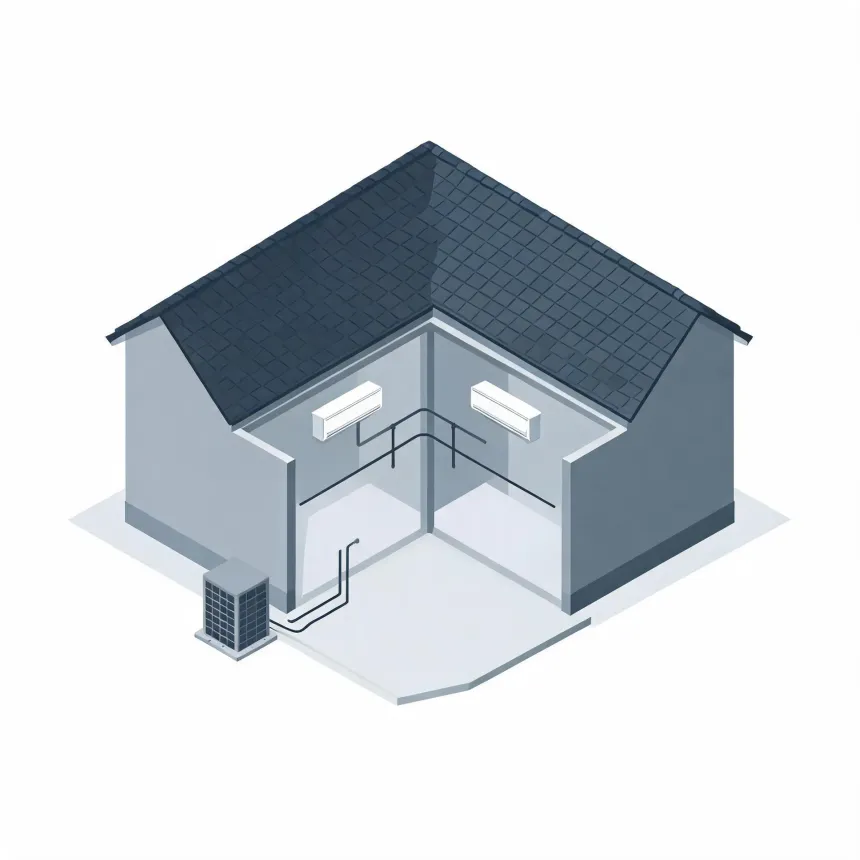
- That depends on the system. A single outdoor unit can run one indoor head or several, and multi-zone systems split the output across several rooms, each with its own indoor unit and thermostat. The right number for your house depends on square footage, how the rooms are laid out, and how much heating and cooling each one needs. A contractor sizes this room by room rather than guessing at it.
- Can a mini split heat a whole house?
- Yes, a multi-zone mini split can heat a whole house if it's sized and placed correctly, with an indoor unit in each room or zone that needs heat. Winter nights here average 25°F, so the system has to be sized for that cold, not just for a mild day. A contractor can work out whether your house is a good fit based on its layout and how much heat it loses in winter.