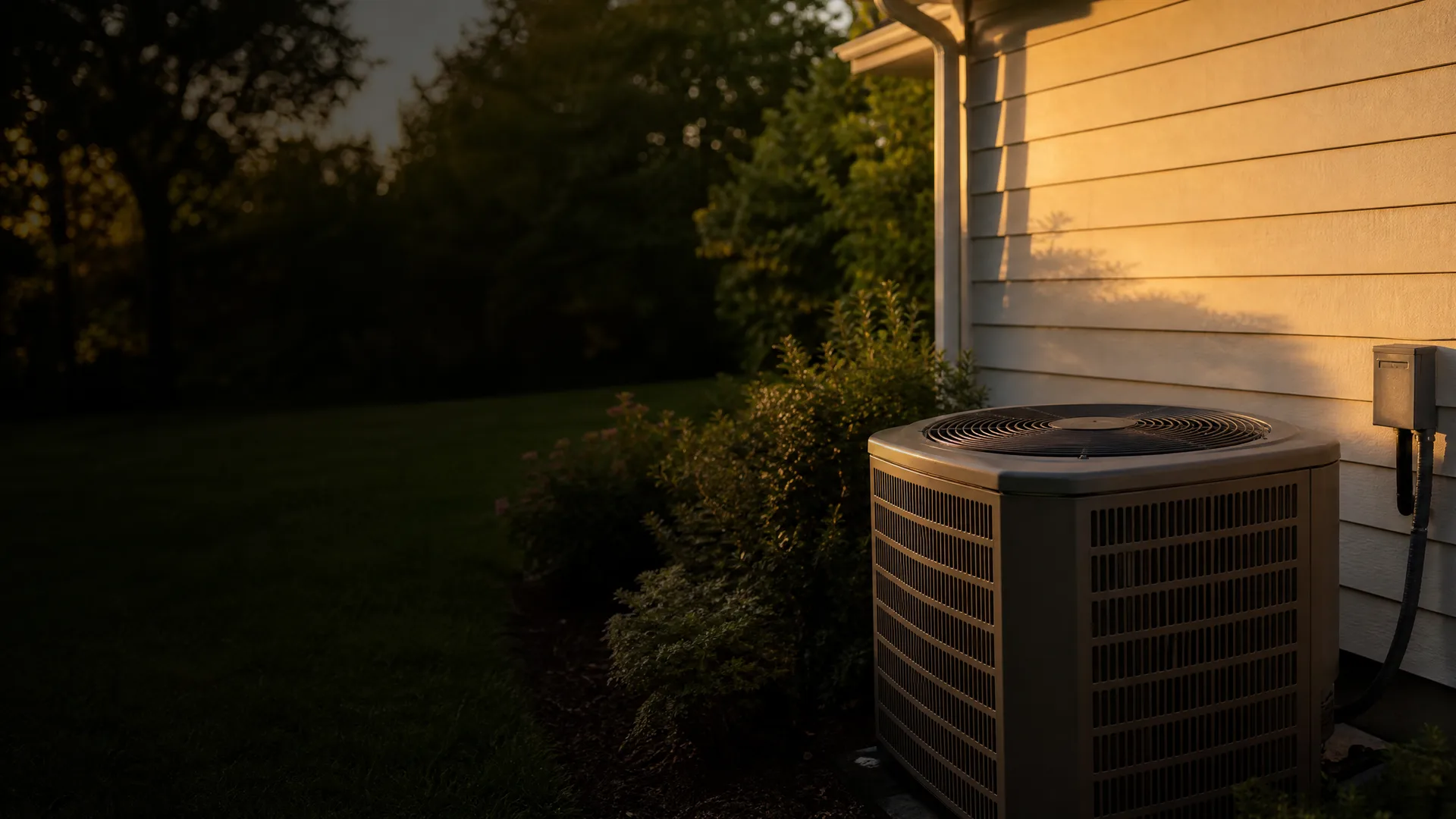
An outdoor air conditioning condenser unit on a concrete pad beside a house with horizontal siding, with an electrical disconnect box on the wall and shrubs to the right in low evening light.

Get your air conditioner to the right pro

What to do when the AC goes out in Missouri

Your AC quits in the middle of a Missouri summer and you need to know what's worth checking yourself and when it's time to get a repair tech on the phone. This page walks through both. Skip the search for who's available and who'll actually call you back, a contractor reaches out once you're matched.

Find an air conditioner pro

First check the thermostat is set to cool and a few degrees below room temperature, then check the breaker box. Humidity in Missouri puts a hard load on an AC all summer, and breakers trip. If the breaker's fine, go look at the outdoor unit. If the fan isn't spinning or you hear the compressor humming without it turning, that's a capacitor or motor problem, not something to fix yourself. Check the air filter too. A filter clogged with dust chokes airflow until the evaporator coil ices over, and once that happens the system can't cool at all until the ice melts, even if nothing else is wrong. If the unit runs but the air coming out isn't cold, or it's blowing warm, that points to a refrigerant leak or a failing compressor, and it needs a technician with gauges to find out which. Most homes here heat with gas, so this is the one system standing between the house and a miserable July, and a short delay getting it looked at matters more here than it would somewhere milder.

Power costs 13.30 cents per kilowatt-hour statewide

At 13.30 cents per kilowatt-hour, running your AC in Missouri doesn't punish your bill the way it does in some states. That's worth knowing before you shut it off to save money while waiting on a repair. A sticky Missouri summer with no cooling is a worse trade than the extra you'd pay to keep it running while you sort out the fix.

EIA-861 2025 statewide residential average

An outdoor air conditioner condenser unit on a concrete pad beside a house wall, with a gray electrical disconnect box and conduit above it and grass in the foreground.

When it's worth waiting a day

If the air coming out is just a little warm and the house is holding steady, a day's wait while you line up a tech usually doesn't cost you much. Close the blinds, run ceiling fans, stay on the lower floor if you have one. A system that's limping along is still moving some air, and that buys you time to find someone who can actually look at the unit instead of taking whoever's free in an hour.

A gray outdoor air conditioner condenser unit on a concrete pad beside a house with horizontal lap siding, surrounded by white gravel and a lawn, with a white wall at left.

When it can't wait

If there's no air moving at all, or the outdoor unit is making a new noise, or the house is climbing past 85 with kids or anyone older at home, this isn't a wait-and-see. Missouri humidity turns a dead AC into a real problem fast, especially for anyone with breathing trouble or a baby in the house. That's when you want someone out the same day, not whenever a slot opens up on its own.

Is your house slowly losing the fight against the heat

You notice it room by room. The upstairs bedrooms get stuffy first, then the air feels heavy even where the vents are blowing. Maybe the unit runs and runs without the house ever feeling cool, or it short cycles, kicking on and off every few minutes. You might hear the outdoor unit humming without the fan spinning, or notice ice on the refrigerant line. Left alone through a Missouri summer, a struggling AC usually means higher humidity indoors, which makes the house feel worse than the thermostat number suggests, and it puts more strain on a system that's already telling you something is wrong.

A woman with dark hair in a bun wearing a cream knit sweater sits on a gray sofa in a bright living room, looking off to the side.
A woman wrapped in a knit blanket sits on a gray sofa in a living room, looking toward a bright window with houseplants and an armchair in the background.
A woman in a gray cowl-neck sweater sits on a light sofa with cushions, smiling and looking to the side, with a kitchen and window visible behind her.
A woman with dark hair in a bun, wearing a light linen shirt, sits on a sofa and looks to the side, with a window, houseplants and a kitchen with pendant lights blurred behind her.

Fan Only or Full Shutdown

Run the fan only

  • The blower moves air through the house but nothing cools it, so rooms stay at whatever temperature they already are.
  • It costs less to run than the compressor, which matters if you're stretching things out over a day or two before a tech comes.
  • Moving air still helps a little, since air passing over your skin feels cooler even when it isn't.
  • It does nothing for humidity, and a Missouri house without the AC running will feel damp fast.
  • If the problem is actually the blower motor or its capacitor, fan-only mode may not work either.

Shut the whole system off

  • No power runs through the outdoor unit or the blower, so nothing can short further or trip the breaker again.
  • If the issue is electrical, like a tripped breaker that keeps tripping, cutting power is the safer move until someone checks it.
  • The house will heat up and hold humidity with nothing moving the air at all.
  • At 13.30 cents per kilowatt-hour, you're not saving much by shutting down, so do this for safety, not to cut the bill.
  • Leave it off if you smell burning or hear a buzzing sound from the outdoor unit. That's not something to run through.
An outdoor air conditioner condenser unit beside a light-colored lap-sided house with an electrical disconnect box on the wall, surrounded by shrubs and lawn in low evening light.

You're out back around seven, grill going, and you notice the quiet. The condenser isn't humming. You walk over and the fan blade is just sitting there, not a twitch, while the sun sits low and orange over the fence line. The air around the unit feels warm, almost thick, same as the rest of the yard. Inside, your spouse has the kids pulling out box fans from the hall closet. You crouch down and look at the side panel, not sure what you're checking for, just checking. Tomorrow you'll want someone who already knows what a dead fan motor means before you say another word about it.


The right pro for this job

Skip searching for an air conditioner pro and answer a few questions instead.

There's no charge for the request.

A dirty outdoor coil makes the compressor work harder to move the same heat, and in a Missouri summer that strain shows up fast as a tripped breaker or a unit that runs nonstop without cooling the house.

Clearing leaves and grass clippings away from the unit and hosing off the coil fins won't fix a failed capacitor or a low refrigerant charge, but it's the one thing you can check with no tools that actually affects how hard the system has to work.

An outdoor air conditioner condenser unit on a concrete pad beside a house with horizontal lap siding, with a conduit running to a gray electrical disconnect box on the wall.
Before you get your air conditioner repair
A gray outdoor air conditioner condenser unit on a concrete pad beside a house with horizontal lap siding, with a wall-mounted disconnect box and conduit at left and a green shrub and mulch bed at right.
After you get your air conditioner repair
Single-story house with gray horizontal lap siding, dark shingled gable roof, a small covered front porch with a dark door, and windows, set behind a patchy green and brown lawn under a clear blue sky.

Averaged across a Missouri summer, the dew point sits at 66°F, according to NOAA climate data. That's the number that explains why the air feels heavy even on a day that isn't especially hot. For your AC, it means the system spends more of its time pulling moisture out of the air, not just dropping the temperature. When the unit is working right, you feel that as a steady, comfortable house. When something's off, a struggling AC in that kind of air leaves rooms feeling damp and sticky even if the thermostat says you've hit your set temperature. That's the gap worth paying attention to while you wait on a repair.

NASA POWER T2MDEW county cells weighted by homes

Why does my outdoor AC unit have ice on it?

Ice on the outdoor unit feels backwards when it's ninety degrees out and your house is warm instead of cool. It's one of the more alarming things to find in a Missouri summer, especially if the system was running fine a day or two before. Most people's instinct is to let it keep running so the house doesn't get hotter, but that's the wrong move.

Turn the AC off and let the ice melt before anything else

Ice forms on the coil inside the outdoor unit when something is blocking normal airflow or refrigerant flow, most often a dirty air filter, a coil caked with dirt, or a low refrigerant charge. Once ice builds up, it blocks airflow even more, so the problem feeds itself and the house gets warmer while the unit runs. Switch the thermostat to off, leave the fan setting alone, and give it a few hours to thaw completely. Running it iced over can push liquid refrigerant back into the compressor, which is a far more expensive repair than whatever caused the ice. Once it's thawed, a tech can find out whether it's the filter, the coil, or the charge.

A gray outdoor air conditioning condenser unit on a concrete pad beside a house with horizontal lap siding, with a wall-mounted disconnect box and conduit, and shrubs to the left.

Unit running clean

This is what a healthy outdoor unit looks like: clear of leaves, sitting level on its pad, fan spinning steady behind the grille. The space around it is open on all sides so air can pull through the coil. Nothing stacked against it, nothing growing up into the fins.

An outdoor air conditioning condenser unit on a concrete pad beside a house with horizontal siding and a concrete foundation, with dry brown leaves on the ground to either side.

Unit in trouble

Leaves piled against the cabinet, grime caked into the coil fins, maybe a season or two of yard debris never cleared away. A unit in this shape has to work harder to move heat outside, and in a Missouri summer that extra strain is often what pushes it to trip a breaker or quit cooling altogether.

A man in a dark blue shirt stands in an open front doorway of a stucco and wood-clad house, facing a blond woman seen from behind in the foreground on a stone walkway.

So that's where things stand

A thermostat set wrong, a tripped breaker, a frozen coil, a condenser fan that's stopped turning. Some of what's going on with your AC you can see for yourself before anyone else shows up. What you can't do from the yard is get inside the unit and fix what's actually broken.

Once you know what you're looking at, the next step is getting someone qualified to look at the rest. That's the part this page hands off for you: instead of searching around for who covers your area and has time this week, you get matched with a contractor suited to what you're dealing with, and they're the one who calls you, not the other way around.

A living room corner with a beige sofa and cushion, a round wooden coffee table holding a pale ceramic vase of eucalyptus stems and a wooden bowl, and a curtained window with a potted plant above a latticed radiator cover in the background.
An older woman with gray hair in a bun and glasses, wearing a beige knit sweater, smiles while looking to the side in a warmly lit kitchen, with a loaf of bread on the counter in the foreground and a snowy scene outside the window.
A woman and a sleeping child wrapped together in a cream knitted blanket on a couch, with a potted plant, framed photo and lit lamp in the background.

Air Conditioner Repair

Matched to your air conditioner job

One form replaces the calls you'd make to find an air conditioner pro.

A black-framed smartphone standing upright against a plain white background, its screen filled with solid green.
RepairCentral ACMissouri
Step 1 of 2

What ZIP code is the job in?