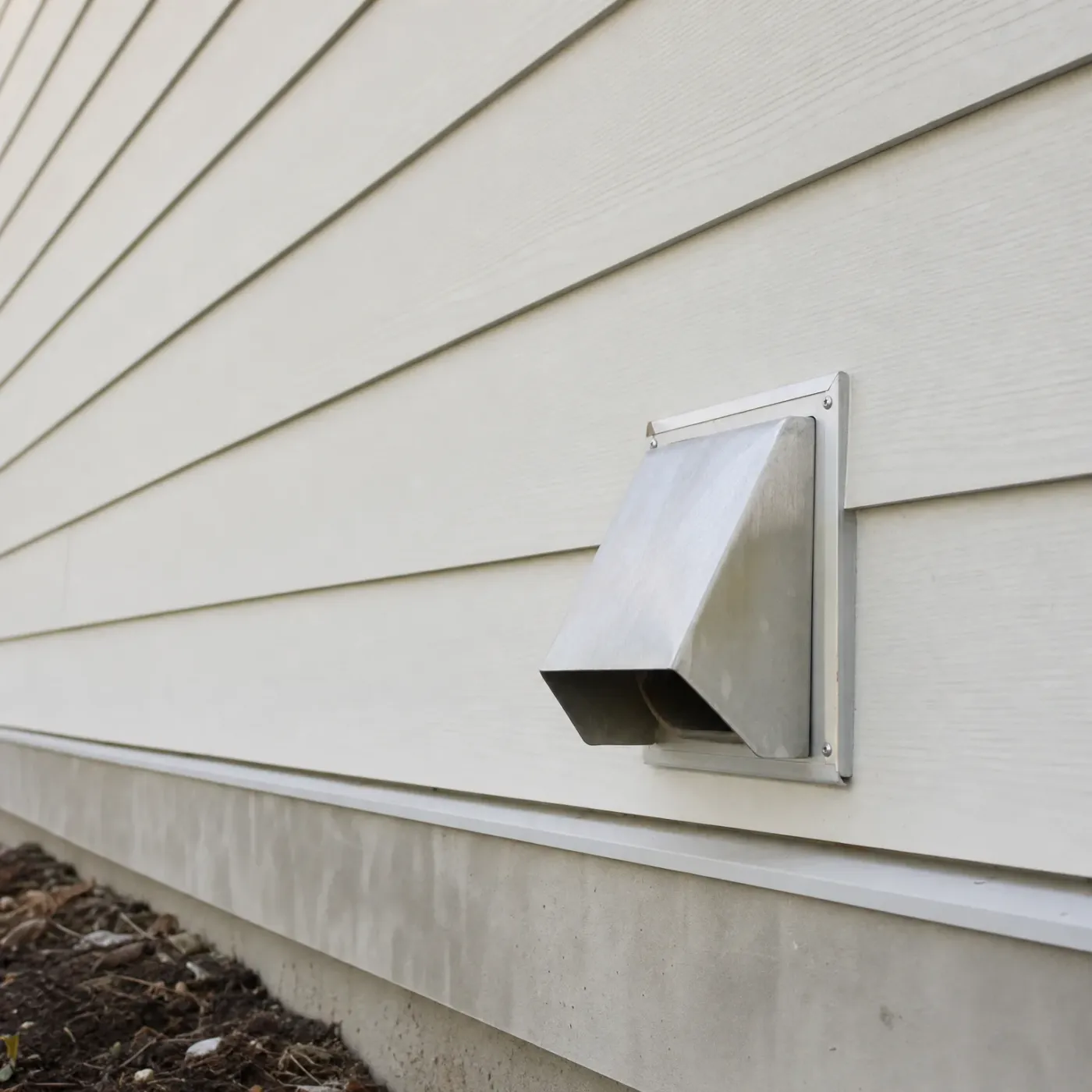
Vent hood clear and open
The flap swings loose and the hood stays open while the dryer runs, letting exhaust out fast. Air carries lint and moisture outside instead of backing up into the duct behind the wall.
Clean your dryer vent once a year. If you run loads most days of the week, or your vent run is long with a few turns in it, go to twice a year instead. Lint builds up along the duct walls over time and narrows the path air needs to escape through. Once that happens, your dryer runs hotter and takes longer to finish a load, and the heat has nowhere to go but back into the unit. Missouri summers get sticky, and a vent that's already restricted struggles more to push air out against that heavier, humid air outside. A clogged vent is also the leading cause of dryer fires, so this isn't just about drying times. If you notice clothes coming out hotter than usual, a burning smell, or the outside vent hood barely moving when the dryer runs, don't wait for the yearly mark. Those are signs it needs attention now.


Your dryer doesn't just dry clothes in the drum. It pushes hot, damp air out of the house through a duct that runs from the back of the machine to a cap on your wall or roof. That duct is doing the real work of getting moisture out of your home. Every load sheds lint, and the trap in the door only catches a portion of it. The rest travels with the airflow and settles along the duct walls, especially at bends. A straight run with one exit point stays clear longer than a run with two or three elbows in it, because every turn gives lint a surface to catch on and build up. As that buildup narrows the path, the blower inside the dryer has to work harder to push the same volume of air through a smaller space. You'll notice it as longer dry times or a dryer that runs hot to the touch. In Missouri, the thick summer air plays a part too. Moisture in that air mixes with lint sitting in the duct and makes it clump instead of blowing loose, so the buildup packs in tighter than it would in a dry climate. A real cleaning reaches past the trap, pulling lint from the full length of the duct, from the connection behind the dryer out to the cap itself. That's the part of the system you can't see and can't clean yourself with a vacuum.




Your dryer vent cleaning request goes to one local pro.
Describe your dryer vent job once, to one pro.
It costs nothing to send, and you don't have to hire anyone.

The flap swings loose and the hood stays open while the dryer runs, letting exhaust out fast. Air carries lint and moisture outside instead of backing up into the duct behind the wall.

Lint has filled the hood and jammed the flap open, so the dryer can't push air out fully. What doesn't escape builds up further back in the duct, and the next load takes longer to dry.


A technician checks the vent hood outside to see how much lint has already packed it.
A brush on a flexible rod feeds through the duct from the vent opening.
The brush breaks up packed lint while a vacuum pulls the debris out.
The technician works the full run, including every turn, until the duct is clear.
At 13.30 cents per kilowatt-hour, a dryer forcing air through a clogged vent runs longer to finish the same load, and that extra time shows up on your bill. Keeping the vent clear keeps your dryer from working harder than it has to.
EIA-861 2025 statewide residential average



Once a year keeps a normal vent run clear. Twice a year makes sense if you're drying loads most days or your duct is long and bends a few times getting outside. Past that, it's the same job every time: clear the lint, open the path, let the dryer breathe the way it's built to.
You could spend an evening finding someone who does this, calling a few numbers, explaining the vent run and the roof cap twice over, then sitting with quotes trying to tell them apart. Or you could hand it to a local tech who clears these vents all year in Missouri homes and already knows what a packed hood or a long duct run tends to do. One call, one person who shows up knowing the job.


Describe it once